


Select the product, family and period
Define the flow for which takt time is calculated and the customer demand that must be met during a shift, day or week.

Instant consultation, immediate impact. Why wait?
 Let's dive right into how Iwoscan can reshape your manufacturing pipeline
Our experts are here to guide you through the transformation
No strings attached
Welcome to the Iwoscan!
At Iwoscan, we are more than just a company; we are the pioneers of precision and efficiency, the architects of innovation, and the champions of progress.
Sign in and embark on the journey together!
If you still need to register, we encourage you to create an account and elevate your experience. You'll gain:
- Exclusive access to analytics
- The ability to personalize your experience
- Receive notifications and stay updated
Takt time shows how often one good unit must be completed to meet customer demand during a selected period. It is calculated by dividing available production time by the required quantity. Iwoscan records actual cycles, completed quantity, downtime and its reasons, showing where the process does not meet the calculated takt time.
Odoo ERP friendly Built-in task splitting and merging Raw data without distortion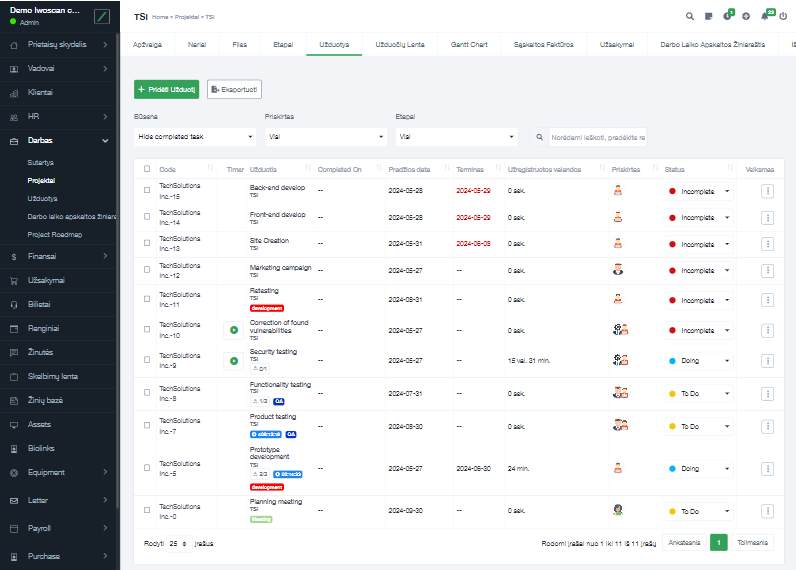
Takt time is not a speed record assigned to an employee. It is a planning reference that links customer demand with available production time and helps balance the entire process.
Calculating takt time is only the beginning. Value appears when planned demand, actual cycles, good units and process losses are compared over the same period.
Define the flow for which takt time is calculated and the customer demand that must be met during a shift, day or week.
Subtract agreed scheduled breaks, meetings and other planned non-production time from the calendar shift time. The calculation rule must remain consistent across comparisons.
Divide available time by the required number of good units. The resulting seconds or minutes are the interval at which the flow must provide one good unit.
Record individual cycles, completed quantity, defects, downtime, changeovers and their reasons. Link the data with the workstation, task, shift and product variant.
Adjust work elements, tools, material supply or capacity allocation. Compare the same indicators again after the change, and recalculate takt time when actual demand changes.
Iwoscan does not replace the production plan or set takt time without demand data. It collects actual data, links it with the plan and shows what prevents the process from maintaining the required rhythm.

See not only the average duration but also individual cycle recurrence and deviations.

When planned quantity and time are provided, you can see whether a shift, task or workstation is progressing at the required pace.

Downtime, defects, material waiting, changeovers and other events are linked with the specific time and task.

Cycles can be compared by product, workstation, shift and period so that an overall average does not hide differences.

Before-and-after comparisons can include cycle time, stability, downtime, defects and completed quantity.

The plan can be received from the existing system, while actual cycles, quantities and losses can be returned or exported.
Briefly describe the process, equipment and data that is currently missing.
We will explain what can be recorded, which Iwoscan set is suitable and how the data can reach your systems.
Takt time is the interval at which a process must provide one good unit to meet customer demand. It is calculated by dividing available production time by the required number of good units during the same period.
Use the production time actually scheduled: subtract planned breaks, meetings and other scheduled non-production time from shift length. Unplanned downtime should not be subtracted because it represents process loss.
Takt time is calculated from demand and available time. Cycle time is the measured duration of one unit or operation. Lead time covers the entire journey through the process, including waiting between operations.
Takt time can be calculated for a product family or the pacemaker process that controls the main flow. Actual cycles for different variants should be assessed separately, while the overall rhythm is planned using an agreed demand period and product mix.
Reliable demand and available-time data are required. When they are supplied from the plan, ERP or MRP system, the takt interval can be calculated and compared with actual cycles, quantities, defects and downtime collected by Iwoscan.